PLC Simulator

PLCdev is your home for quality simulators for Programmable Logic Controllers from Allen Bradley, GE Fanuc, Siemens, Modicon, Mitsubishi, Omron, Automation Direct and anything else you're using. We specialize in making PLC test boards to simulate your control environment so that you can debug your programs on your desk or in the field. And if that wasn't enough we offer educational materials, articles and tips for the novice to the advanced programmer. We invite you to register so that you can receive timely updates to PLCdev. Thanks for coming and visit again soon!

Book Review: Programmable Logic Controllers by Frank Petruzella

cover of Book Review: Programmable Logic Controllers by Frank PetruzellaProgrammable Logic Controllers

author: Frank Petruzella
rating:
ASIN or ISBN-10: 0078298520
binding: Hardcover
amazon price: $253.59 USD


I really like this book.  The text discusses PLCs in a general sense even though the examples and exercises use the Allen Bradley line of PLC-5, SLC-500 and ControlLogix PLCs extensively.  So if you are student seeking to gain a good working knowledge of one of the most popular PLCs on the market then this is your book.  It deals very thoroughly in a basic and intermediate level, touching on some advanced concepts as well.  Some nice extra material not found in other books is chapter 13 on PLC Installation Practices, Editing and Troubleshooting.    The b


Modbus FAQ

General

1. What is MODBUS?

MODBUS is a commonly used industrial communications protocol. It allows the exchange of data between PLCs and computers. It was originally designed for Modicon (Schneider Electric) PLCs but has become widely used by many PLC manufacturers and industrial networks.

2. Why would I use MODBUS?

MODBUS is a common means of gathering data from many different sources for viewing operations, archiving and troubleshooting from a central remote location. It is widely used and a fairly simple protocol. Depending on the application a newer protocol may have more advantage.


An Interview with Mike Kraft

I'm a big fan of the retro-encabulator spoof so it was a great surprise to have the actor in the video, Mike Kraft, respond to my plea for more information.


( categories: )

How PLCs Work

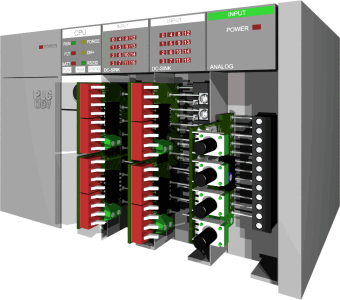
A programmable logic controller is a specialized computer used to control machines and processes.  It therefore shares common terms with typical PCs like central processing unit, memory, software and communications.  Unlike a personal computer though the PLC is designed to survive in a rugged industrial atmosphere and to be very flexible in how it interfaces with inputs and outputs to the real world.

The components that make a PLC work can be divided into three core areas.

  • The power supply and rack
  • The central processing unit (CPU)
  • The input/output (I/O) section

PLCs come in many shapes and sizes.  They can be so small as to fit in your shirt pocket while more involved controls systems require large PLC racks.  Smaller PLCs (a.k.a. “bricks”) are typically designed with fixed I/O points.  For our consideration, we’ll look at the more modular rack based systems.  It’s called “modular” because the rack can accept many different types of I/O modules that simply slide into the rack and plug in.


Book Review: Programmable Controllers by L.A. and E.A. Bryan

cover of Book Review: Programmable Controllers by L.A. and E.A. BryanProgrammable Controllers: Theory and Implementation

author: L. A. Bryan
E. A. Bryan
rating:
ASIN or ISBN-10: 0826913008
binding: Paperback
list price: $110.00 USD
amazon price: $110.00


Programmable Controllers by L.A. Bryan and E.A. Bryan has been around for several years (first published in 1988) and is now in a second edition (1996). Its longevity is due to it's well written style, clear organization and it's generic nature which covers many PLCs. It's a book that targets an intermediate beginner level. So it's not a "PLC for dummies" book yet it might leave the advanced PLC programmer wanting more.


( categories: )

Time Engineers


Time Engineers

Time Engineers is a really cool looking game that teaches kids fundamentals in engineering. It's aimed at middle and high school ages even though it looks entertaining (and maybe even educational) for adult engineers. The basis of the game is to unlock the time travel machine and go back to help cultures in the past with their engineering problems.  For instance you could help the Egyptians build the pyramids or design a draw bridge in Medieval France.


The thing that really tickled my fancy is the first two exercises involve principles that I've included in my PLC tutorial.   The first hurdle involves the time traveler having to use decimal to binary conversion to open up the door to the machine.  After that, a series of switches must be set using Boolean functions like AND, OR and NOT to power up the time machine.

I love educational software like this.


( categories: )

The Decision Makers: AND, OR and NOT

Life is full of decisions. What is true for us is also true of PLCs. We gather information (input) and based on that we make choices that determine our output. All though I've always found computers to be quite a bit more logical then human beings.

For an example of how we use logic in everyday life consider these statements:

  • If Tommy OR Bob want to play basketball then I'll play too.
  • It's 6 o'clock AND I'm NOT hungry therefore I'm going to keep playing.
  • If Mom comes out AND orders me inside OR it get's dark then I'll stop playing.

Now these are pretty simple decisions especially if you're a ten year old boy.  You'll notice that they all involve three types of comparisions: AND, OR and NOT.  Now we could get more complex but all that we'd be doing is using these simple building blocks.

In the world of automation these types of TRUE or FALSE conditions come down to a device being ON or OFF, CLOSED or OPEN, PRESENT or ABSENT, 24 VOLTS or 0 VOLTS.  In the PLC it all boils down to our now familiar binary system of a 1 or a 0.  Typically having a bit ON represents a TRUE condition while OFF is FALSE.  This is abitrary though as it may make more sense to use what is called failsafe logic and have an ON bit as a FALSE condition.


Review of AutomationDirect's DirectSOFT5 Programming Software

I've been a consistent user of DirectSOFT for the last six years so I was very interested to check out AutomationDirect's new release of DirectSOFT5.  This is both an overview of the new features and a review as to their usefulness.  We’ll start with some first impressions like new icons, toolbars, themes and dockable views and then discuss the important internal changes with IBoxes.  There have also been significant moves made in how Automation Direct packages and sells DirectSOFT which should factor into whether to upgrade or not.


( categories: )

PLCs Versus Other Types of Controls

A PLC is not the only choice for controlling a process. Sticking with only basic relays may be of a benefit depending upon your application. Yet, on the other hand, a computer might be the way to go. The PLC vs. PC debate has been going on for a long time. More often though it doesn't come down to an "either or" situation but involves a mix of technologies.

PLC vs. Relay

Relay small


When I first started programming PLCs it was still questionable if a PLC was necessary over just relay control. With PLC prices going down, size shrinking, and performance of PLCs improving over the years this has become less of a battle. Yet the designer has to ask themselves if a PLC is really overkill for their application. Some questions should be asked.

  • Is there a need for flexibility in control logic changes? Will there be frequent control logic changes? Will there be a need for rapid modification?
    A lot companies believe they will never change a design but more often then not ideas and goals do change and modifications will need to be made. Do you want to do that in hardware (relays) or software (PLC)?
  • Must similar control logic be used on different machines?
    It's so much easier to download a program then build another panel.
  • Is there a need for future growth?
    A PLC can easily accept a new module in a slot or get an expansion base.
  • Is there a need for high reliability?
    PLCs are seen as more robust over individual components.
  • Is downtime a concern?
    Any change or troubleshooting on a relay system means the system might have to go offline. Changes in a PLC can often be made online with no downtime.
  • Are space requirements important?
    Based on the number of relays a PLC can be a real space saver.
  • Are increased capability and output required?
    PLCs can be faster then their mechanical counterparts.
  • Are there data collection and communications required?
    Only possible with a PLC or computer.
  • What are the overall costs?
    There's a certain price point comparison but in these days it's very low in favor of a PLC.

Impressive Student Control Projects

Lately I've run across some very cool PLC control projects done by university students that I'd like to share.

Assitive Technology

A couple of examples come from the Introduction to Programmable Logic Controllers in a Mechanical Engineering Instrumentation Course taught at the University of Alabama. It sounds like a really neat hands on environment for some practical learning about PLCs and control systems. The document outlines development of a PLC test stand for the class using an Automation Direct DL205 PLC with several pneumatic cylinders, solenoid valves, proximity sensors, pressure regulators, DC power supplies which are mounted on a peg board.

The really fun part comes with two of the senior projects. In practice they are great examples of assistive technology. One is a page turning device using an Automation Direct DL05 and parts that were scavanged from an old dot matrix printer.